
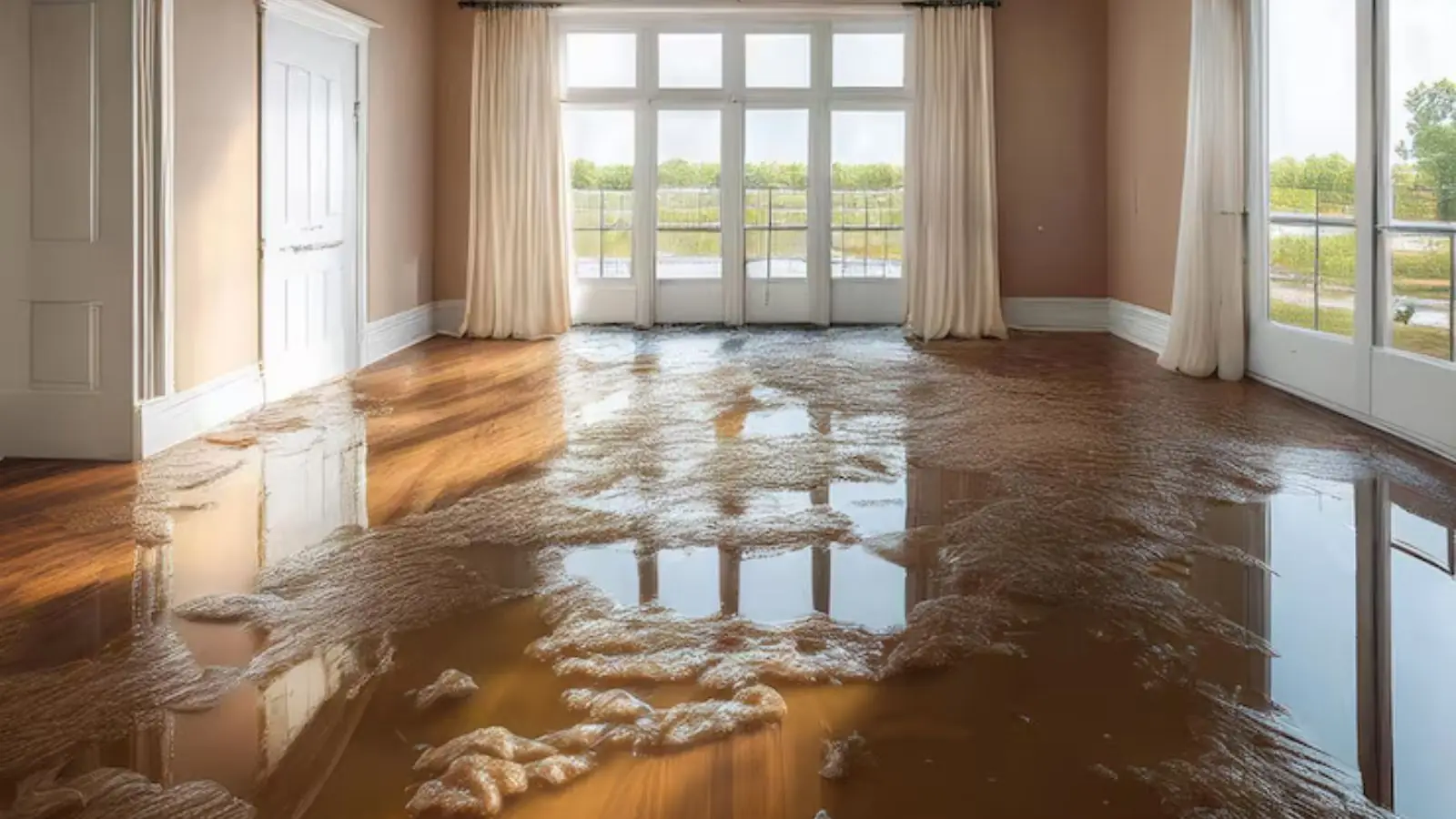
Water damage to a wood floor shows up as cupped edges, a crowned center, gaps, dark stains or boards lifting off the subfloor. Each sign points to a different moisture pattern, and each pattern has a different fix.
Wood is a sponge that swells across its width. When one side of a board stays wetter than the other, the board bends. That bending, called cupping or crowning, is the most useful clue a homeowner can read without any tools, and this guide explains how to use it.
Reading the damage
Cupping means the edges of each board rise higher than the center, so the floor feels like a washboard. It usually points to moisture rising from below, such as a slab, a crawl space or a leak under the boards.
Crowning is the reverse, with the center higher than the edges. It often appears after a floor has been sanded while still too damp or after cupped boards dry out from the top. Buckling is more serious, when boards lift off the subfloor completely.
Dark rings around nail heads are another warning sign. They suggest moisture has reached the fasteners and been there long enough to react with the metal and the wood.
Cupping
Edges up, center down. Moisture from below or one-sided wetting.
Crowning
Center up, edges down. Often seen after drying or aggressive sanding.
Gaps
Boards shrink apart as they dry out after swelling.
Dark stains
Black or gray marks that follow the grain suggest long-term moisture or finish failure.
Buckling
Boards lift from the subfloor and the floor is no longer flat.
How wood floors get wet at home
Three scenarios show up again and again. Typical culprits are a washer hookup that gives way while nobody is home, a dishwasher drain that seeps under the cabinet base, or a clogged condensate drain from the air conditioner that spills beside a closet.
In each case the water starts small and ends up under the boards. By the time the room smells damp, the subfloor beneath may be wet as well, which is why surface checks alone mislead.
Slab-on-grade homes add one more route. Moisture can rise through a concrete slab under a glued or floating floor, so a floor can cup even when nothing visibly leaked above. A moisture meter and a plastic sheet test over a few days will tell you whether the source is above or below.
Want the damage looked at in person?
Call to schedule an inspection of the ceiling, wall or floor before anything is cut out.
Dry, refinish or replace
The best outcome depends on how quickly drying started and how deeply the water went. The table is a rough guide, not a verdict on your floor.
Engineered flooring behaves differently from solid planks, because its layers can separate when wet. If you are not sure what you have, check a board edge or a vent opening, since manufacturers print the construction on the box or the specification sheet.
| Floor condition | Likely path | What decides it |
|---|---|---|
| Light cupping after a short leak | Dry, then sand and refinish if needed | Boards flatten as moisture equalizes, so time and drying matter |
| Cupping that does not relax after drying | Refinish or partial replacement | Moisture readings and board flatness over several weeks |
| Buckled boards | Replace affected section | Fastening and subfloor condition |
| Black staining through the finish | Replace stained boards | The stain is often in the wood, not on top |
| Sewage or floodwater contact | Replace | Porous material touched by contaminated water is not cleaned in place |
A floor that looks flat on day two can still be wet beneath. Waiting for a moisture reading before refinishing prevents the gaps and cupping that otherwise return.
Specialized drying for wood
Wood floors dry slowly and unevenly. Crews may use low-profile air movers, dehumidifiers and sometimes mats or panels that pull moisture from beneath the boards.
Drying too fast can split boards, so progress is measured, not rushed. Our water mitigation crews log readings each visit and stop equipment only when the wood and subfloor read in line with a dry reference.
What to do before anyone arrives
Stop the source and soak up standing water with towels or a wet vacuum. Lift rugs, furniture legs and anything that traps moisture against the floor, and avoid dragging heavy items across softened boards.
Shut off the supply
Close the washer valve, dishwasher valve or main shutoff.
Remove standing water
Use towels or a wet vacuum, and keep the room ventilated.
Lift what traps moisture
Rugs, mats and furniture stay off the floor until dry.
Photograph everything
Record the boards before they move so you have a baseline.
Skip heat and fans pointed straight down
Aggressive drying can crack boards. Let readings guide equipment.
Repair after drying
Once the floor and subfloor are dry, the question becomes cosmetic. Light cupping often relaxes enough that sanding and a fresh finish are all that is needed.
When boards need replacing, matching species, width and stain takes care. Our water damage repair page explains how rebuild work follows drying, so you are not paying to refinish a floor that will cup again.
Ask for the readings in writing before refinishing. A dry floor is a measured result, not an impression, and it is the best protection against paying twice for the same board.
Wood floors near Lawndale and El Segundo
Readers near the Sepulveda and Hawthorne Boulevard corridors often live in Lawndale or El Segundo. In Lawndale the city's website lists a Building and Safety office on Burin Avenue and a schedule that closes construction off on Sundays and observed holidays, so sanding and board replacement have to fit inside weekday and Saturday daytime windows. Ask the office for the exact hours before booking a floor crew.
Federal EPA guidance puts it simply: mold only grows where moisture lingers. It gives a humidity ceiling of 60 percent, with 30 to 50 percent as the comfortable target. A cheap hygrometer in a room with wood flooring warns you well before a board starts to cup.
Questions about water damage to wood floors in manhattan beach
Will my cupped wood floor flatten on its own?
Often, if the source is fixed and the floor dries slowly and evenly. Flattening can take weeks, so decisions about sanding should wait for stable moisture readings.
Can a wet hardwood floor be saved after a washer valve break?
Frequently, when drying starts quickly and the water was clean. The longer the boards stay wet, the more likely staining, buckling or replacement becomes.
Why is my floor gapping after a leak?
Boards swell when wet and shrink as they dry, so gaps can open between them. Small gaps can close with normal humidity, while large ones may need board replacement.
Should I refinish right after the floor looks dry?
No. Surface dryness is misleading. Wait for readings in both the boards and the subfloor so the finish does not trap moisture.
Do repairs in Lawndale or El Segundo need a permit?
Permit rules vary by city. Sanding and refinishing are one thing, while opening or replacing the subfloor is another, so call your own city's permit counter before the work is scheduled.