
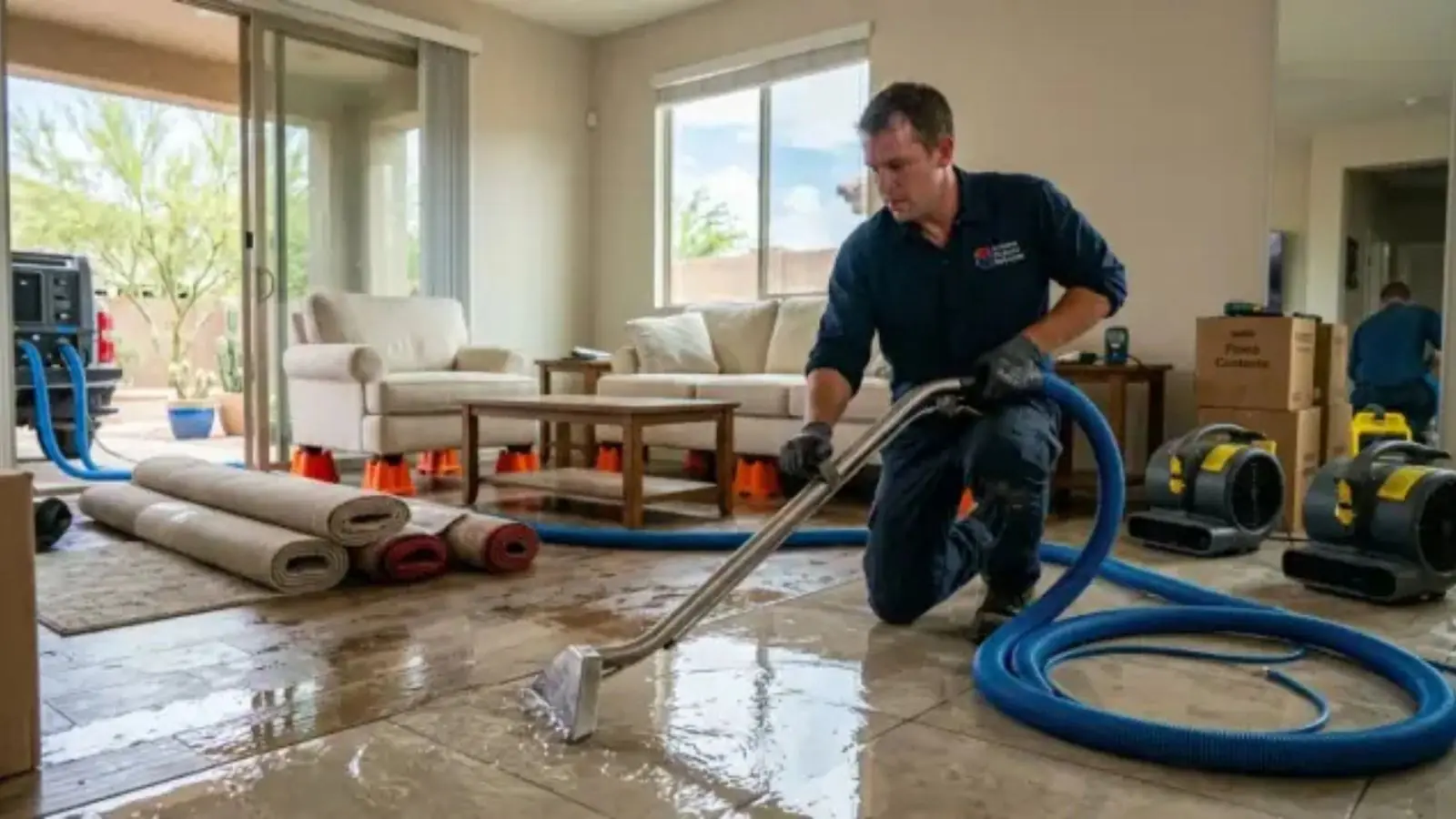
Emergency water removal in Manhattan Beach, CA means pumping and extracting standing water from floors, carpet and low areas as fast as the situation allows. The line is open 24/7, and you do not have to wait for business hours when water is spreading.
Until the crew pulls up, close the main supply, lift valuables off the floor, and keep kids and pets away from anything that could be dirty. Cut the breaker for a soaked room just when the route to the panel is dry.
Removal is the first physical step in recovery, and it is different from drying. Extraction takes out the bulk of the liquid. Drying equipment then pulls out what soaked into materials, which is covered on the water mitigation page.
When standing water is an emergency
Water travels fast once it leaves a pipe or appliance. Within minutes it creeps under baseboards and into subfloor seams, and a day or two later mold starts to take hold. The EPA's target for getting wet materials dry is one to two days, a tighter window than most people assume.
Treat these situations as urgent and call the dispatch line right away.
A pipe or supply line has burst
Water under pressure keeps coming until the main valve is closed. The longer it runs, the more rooms it reaches.
Water is spreading across a floor
A film of water on hardwood or laminate can wick into seams and swell boards within hours.
Carpet is soaked
Wet carpet and pad hold water like a sponge. Extraction with a weighted wand pulls out far more than a household wet vac.
Water is coming through a ceiling
Overhead water pools in insulation and drywall and can bring down a sagging board. Keep clear of the area beneath it.
Sewage is involved
Raw sewage is a safety problem as well as a cleanup problem. Stay out, and see the flood damage page for how it is handled.
Stay safe before anyone arrives
When water has reached outlets, appliances, the panel or a light fixture, keep out of that room. A smell of gas or visible sparking means 911 or the utility comes before the restoration line.
After the hazard is under control, photograph the water and the damaged items. A minute of photos now saves arguments with an insurer later.
Standing water right now?
Stop the source if you can reach it safely, then call. Crews can start on extraction the same day when available.
How the water gets taken out
A crew starts with a walk-through, a look at where the water came from, and moisture readings to see how far it traveled. A thermal imaging camera helps find wet areas that cannot be seen. Then the pumping and extraction begins, always from the deepest areas toward drier ones.
Standing water more than an inch or two deep is moved with submersible pumps. Carpet, pad and hard floors are worked with extraction units, from compact portable machines to larger truck-mounted systems. After extraction, the crew sets air movers and dehumidifiers, and a final moisture check confirms what still needs to stay on.
| Equipment | What it does | Typical use |
|---|---|---|
| Submersible pump | Moves deep standing water out of the structure | Flooded rooms, crawl spaces, below-grade areas |
| Portable extractor | Lifts water from carpet, pad and hard floors | Single rooms, upper floors, tight access |
| Truck-mounted extractor | Higher suction with a long hose run | Large areas and whole-floor losses |
| Moisture meter | Reads moisture in drywall, wood and subfloor | Decides what has to keep drying |
| Thermal imaging camera | Shows cooler wet areas behind surfaces | Finds hidden water in walls and ceilings |
Burst Pipe Water Damage
Burst pipes show up in many forms. Water arrives from a pipe under a kitchen sink, a washer supply valve that fails while nobody is home, a water heater line, or a frozen-and-cracked line in a garage. Each one can put water on the floor of multiple rooms in a short time.
Find the main shutoff before you ever need it, and turn it all the way closed. If it is safe, a tap opened on the ground floor bleeds off whatever pressure is left in the lines.
Call the emergency line next, then move belongings off the floor. The crew pumps and extracts, finds the wet cavities with meters, and removes ruined materials such as swollen toe kick or saturated pad. A plumber still needs to repair the pipe itself, because restoration crews remove water and dry the structure rather than fix the plumbing failure.
Why water removal speed matters in a city like this one
A city Public Works memo in Manhattan Beach cites roughly 120 gallons used per resident daily, with about 90 of those gallons inside the home. A fitting that fails while you are away can release far more than a house can absorb. Checking where your shutoff is before a trip is a cheap way to cap a loss.
Water reaches the city through West Basin Municipal Water District Division III, and the city also draws on its own groundwater rights. That matters in one practical way: the supply to your home is steady and under pressure, so a broken line keeps running until someone closes a valve.
Homes in the Sand Section near The Strand, the Hill Section above it, and the Tree Section streets all have the same first step. Find the main valve, close it, and call.
DIY wet vac or a crew: an honest comparison
A shop vacuum can handle a small spill. Beyond that, the table shows where the limits sit.
| Approach | Works well for | Where it falls short |
|---|---|---|
| Household wet vac and towels | A small spill on a hard floor, caught within minutes | Cannot reach water in pad, subfloor or wall cavities |
| Rented extractor | One room of carpet when no contamination is present | Leaves moisture behind without meters, air movers and dehumidifiers |
| Professional crew | Burst lines, multi-room water, soaked pad, any gray or black water | Needs scheduling, though dispatch is open 24/7 |
If the water was contaminated, skip the DIY options entirely. Sewage and storm-driven water belong to the flood damage restoration process, not a household vacuum.
What the emergency crew explains before pumps start
Most callers want a figure up front, but the true answer depends on what the water reached. A technician looks the property over and walks you through scope and price before the work begins, so the plan is clear before pumps start whenever conditions allow.
In an active flood, extraction can start immediately with written details following once the water is controlled. Crews can often get to you the same day, and a late-night call is handled just like a midday one.
What affects the cost of emergency water removal
No two losses are alike, so these five factors explain most of the differences.
| Emergency cost driver | Effect on the removal job |
|---|---|
| Category of water | Clean supply water leaves more to save, while contaminated water adds hauling and sanitizing |
| Reach of the spill | Extra rooms and square footage mean longer pumping and more machines |
| What got soaked | Carpet with pad, hardwood, laminate and drywall each react differently |
| Equipment and days | Air movers and dehumidifiers run as long as the moisture readings call for |
| Follow-on rebuild | Materials that must come out add to the rebuild list after drying |
A burst pipe is the sort of sudden, accidental event homeowners policies commonly respond to. Slow leaks and neglect usually fall outside, and rising floodwater usually calls for a stand-alone flood policy. Read your policy or ask your agent, log every call, and save receipts for any temporary protection.
For a figure tied to your own house, call (424) 550-5662.
Water removal across Sepulveda, Aviation and the neighboring cities
Crews reach homes and businesses along Sepulveda Boulevard, the city's main north-south highway, and on the eastern side near Aviation Boulevard. Condos and offices in Manhattan Village and Liberty Village often share plumbing stacks with neighbors, so tell the property manager as soon as water appears in a ceiling.
Water emergencies do not stop at the city line. The El Segundo service page describes how Public Works there operates the water and sewer systems, which matters if the leak began on the other side of the border.
After the water is out, the next stage is drying and monitoring. That work is described under water mitigation, and rebuilding comes later.
Common questions, answered for Manhattan Beach
Do you handle water removal emergencies at night or on weekends in Manhattan Beach?
Dispatchers answer at all hours, covering nights, weekends and holiday dates. A crew can often reach you the same day, and a call at 3 a.m. gets the priority a noon call would.
Tell the dispatcher what the source is and whether electricity or sewage is involved, so the right gear goes on the truck.
Should I turn off the electricity before water removal?
Only when the route to the panel is dry underfoot and the panel itself is dry. If water touched the outlets or the panel itself, stay out, ring 911 or the utility, and then call us.
How fast does standing water need to come out?
As quickly as it can be arranged. the agency's drying target is one to two days, which heads off mold, and pulling out the bulk of the water is what makes that deadline realistic.
Can you remove water from hardwood floors and carpet?
Yes. Hardwood is worked with specialized drying mats and low-profile extraction, and carpet and pad are worked with weighted wands. Whether the carpet and pad can stay depends on the water category and how long they sat wet.
What if the water came from a toilet backup or sewage line?
Treat it as contaminated and stay out. The cleanup follows a different process than clean-water removal, and it is described on the flood damage restoration page. Call the emergency line and say sewage is involved.
What should I document for my insurance claim?
Photograph the water, the source and each damaged item before anything moves. Keep a call log and receipts for temporary protection, and wait to discard anything damaged until your adjuster has looked at it.